In this article
- 01A family built on craftsmanship
- 02How Liberty found Prevost
- 03What 10,000 hours actually buys
- 04The engineering decisions that define a Liberty Coach
- 05Solving the weight problem
- 06How Liberty approaches technology
- 07The Liberty Coach community
- 08What makes a Liberty Coach worth the price
- 09What stays
- 10Frequently asked questions
A German pattern maker. A 1954 Greyhound with two and a half million miles on it. A six-year-old kid learning fiberglass repair on the floor of a broken-down motorhome in Minnesota. We sat down with Frank Konigseder, second-generation owner of Liberty Coach, to talk about how all of that became one of the most enduring names in Prevost conversion.
A family built on craftsmanship
Frank Konigseder grew up in his father's foundry on Morrow Avenue in North Chicago. His grandfather had brought the trade over from Germany in the 1920s: a pattern shop first, then an aluminum foundry by 1937, the year Frank's father (Frank Sr., also a pattern maker) was born. The foundry would run for 82 years. Three generations of Konigseders grew up around it.
The motorhome business started, in retrospect, with a vacation that wouldn't go right.
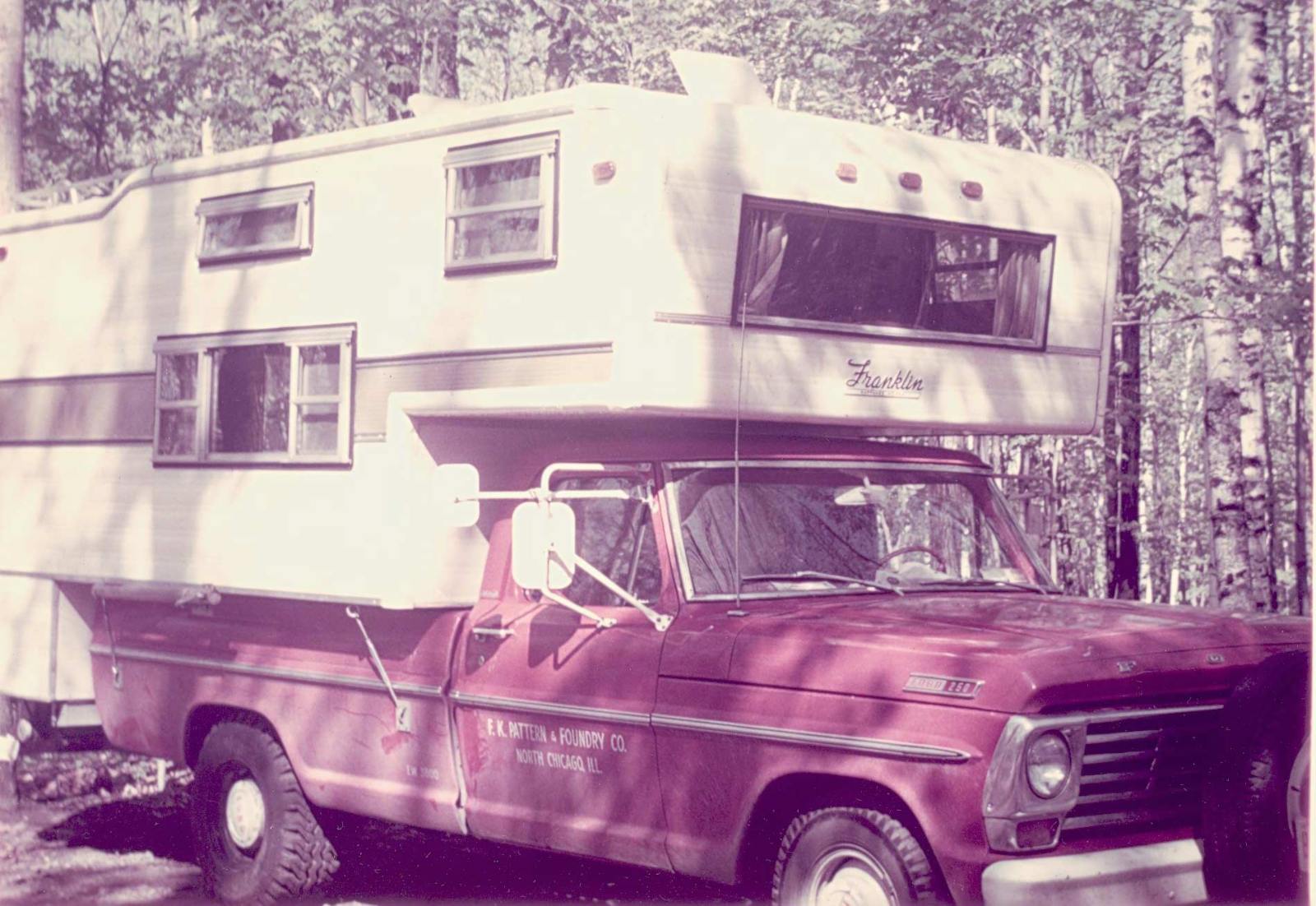
The Konigseders camped the way working families did in the 50s and 60s: a six-man Sears Roebuck tent, a boat behind the pickup, long hauls up to northern Wisconsin. They worked their way up to a slide-in Franklin truck camper in the bed of the same Ford pickup Frank's mother, Jeanne, used during the week to deliver aluminum castings around Chicago.
Then came the Krager motorhome. Mid-60s. Frank doesn't soften his memory of it. "It was just always a headache," he says. The family ended up at the factory in Minnesota for a month, sorting out problems. Frank was six. He learned fiberglass repair on the floor of a vehicle that should have been built right the first time.
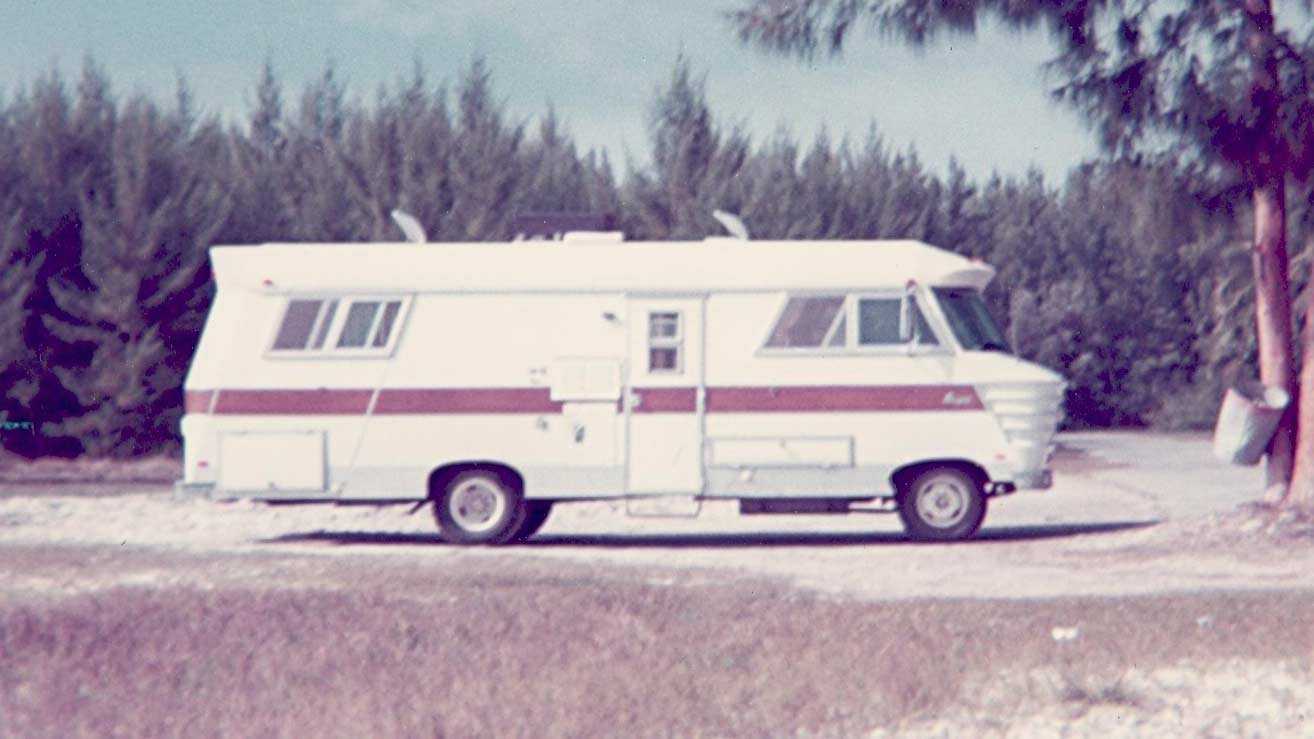
That headache, in retrospect, was the seed of a business.
The foundry already had a relationship with Greyhound, whose corporate headquarters was in Chicago. Frank Sr. was casting aluminum mirror housings and external parts for the buses GM was building, and he could turn them out for less than GM could. So one day he asked Greyhound about buying a used chassis to gut.
At the time, Greyhound was scrapping their old chassis. Cutting them up for the metal. They sold him a 1954 GM 4104, a 35-foot bus with a Detroit Diesel 6V53, dry-sleeve, loud as a freight yard, with about two and a half million miles on the odometer. He spent a year converting it. Pattern maker by trade, cabinet maker by inclination, Frank Sr. hired an electrician and a plumber and did the rest himself. Jeanne sewed the drapes by hand. They painted the outside in their own shop. That was 1968, the first Konigseder conversion.
A year in, somebody offered to buy it. Frank Sr. sold it for $33,000.
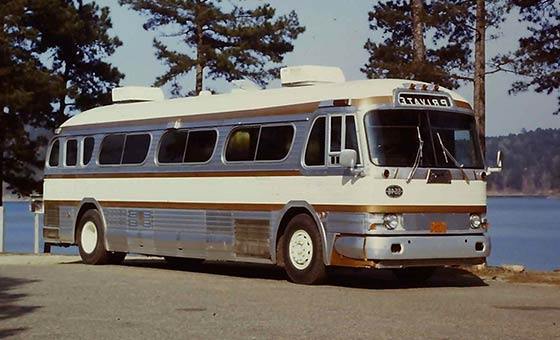
That sale lit the fuse. They bought a Scenicruiser 4501, the double-decker, and did it again. Greyhound suddenly realized there was a market for the very chassis they'd been scrapping. The Konigseders became one of the first Life Members of the Family Motor Coach Association.
How Liberty found Prevost
In the summer of 1978, Liberty had just finished its first MC-7, a 40-footer that finally gave them the room to build a real interior, and they had it on the FMCA show field in Sioux Falls.
Andre Normand of Prevost Car pulled Frank Sr. aside for most of the day. When his father came back, Frank says, "he wanted to show us what we had bought."
It was the Le Mirage, Prevost's purpose-built motorhome chassis, internally called the "MTH" (Motor Tom Harbison), named after one of the other Prevost owners whose dream had been a Prevost shell made specifically for the motorhome industry.
The Konigseders had never seen anything like it. Where Greyhounds had a floor sloped front-to-rear for hose-out cleaning, the Le Mirage had a flat floor. It had windows where Liberty wanted them, made from tinted windshields stood vertical, with sliding panes.
Frank Sr. took the deal. Liberty paid for the interior; Prevost put the shell on consignment with a year to sell it. The coach debuted at the FMCA convention in Del Mar, California, in March of 1979. Liberty took twelve orders, nearly as many coaches as the family had built total to that point. Frank Sr. promised every buyer delivery within a year, and then they had to figure out how to do it.
What Jeanne would later call their "backyard builder" days were over. All production moved to the family's facility in North Chicago, where twenty full-time employees and a rotating supply of part-timers from Great Lakes Naval Base got the coaches built. As Jeanne wrote in her memoir of those years: "The Prevost conversion industry was born ... and Liberty Coach was on its way."
What 10,000 hours actually buys
Liberty puts approximately 10,000 man-hours into the interior of every new coach. That number doesn't include painting (Liberty doesn't paint) or slide installation (Prevost handles that on the chassis side). Liberty builds essentially everything else: driver and passenger seat upholstery, living room chair recovery, the rest of the furniture. The only items they buy finished are the couch, custom-built to their spec, and the living room chair frames.
Roughly 80 employees work in North Chicago. Another 25 to 30 work out of Stuart, mostly technicians. Kurt would add more people up north if he could find them. Talented woodworkers and metalworkers aren't being mass-produced by trade schools.
The family structure runs through all of it. Kurt, Frank's brother, runs manufacturing in North Chicago: floor plan design and cabinet design on every coach, start to finish. "My brother is a phenomenal designer," Frank says. "He can sketch something up with you on a pad, and it's not going to be something like that. It's going to look like that, or better." Kim, Kurt's wife, has been with Liberty for over thirty years and has more than 600 coaches' worth of interior design behind her. Frank's wife Denise runs events. Frank's son, Alex runs Crestron programming. Kurt's sons Nick and Riley are in the business: Nick in the North Chicago office, Riley in the cabinet shop.
Three generations on one payroll. That's not a talking point. It's how you verify that a company means what it says about longevity.
The engineering decisions that define a Liberty Coach
Frank trained as a mechanical engineer. His original role at the company was the foundry: sand cast, permanent mold, the machine shop. That instinct runs through everything Liberty has built since.
- Airbag-mounted generator system (1984)
Frank designed Liberty's rollout generator system to be the quietest and least vibration-prone in the industry. He was the first to put airbags on a generator installation and the first to split the radiator into its own compartment so the genset could run in extreme temperatures without choking itself.
- Automatic leveling and generator start (1984-85)
In 1984, with one other person in the shop, Frank developed Liberty's automatic leveling system. He and a longtime partner co-designed the automatic generator start a year or two later.
- Crestron integration (2001, standard by 2003)
Frank brought Crestron into the RV space in 2001, the first Prevost converter to do it. Every Liberty has shipped with a Crestron-based control system since 2003. People sometimes call Crestron old technology. Frank disagrees, and he's not particularly polite about it: "I don't find anything old about Crestron. They evolve faster than you can imagine."
- Moritz/Octoplex electrical architecture (2006)
Pulled from the marine industry and put into Liberty production in 2006. "If something were to go wrong with that or they have a problem," Frank says, "you could lose half a year's production just trying to wind another electrical architecture into a coach." Twenty years in, that system is still the backbone.
- Lithium-ion battery technology (2010, moved to Voltagen 2016)
Frank started looking at lithium-ion in early 2010 and made the full switch that same year, on Liberty's first 2011 model year coach. In 2016 they moved to Volta, now known as Voltagen. Frank's son manages all communication layers of the lithium architecture through every coach built since.
Solving the weight problem
When the industry started expecting slide rooms in luxury coaches, the chassis manufacturers didn't take any weight out of the bus to compensate. So Liberty had to. Kurt led that effort, and he didn't find the answer in the RV world. He found it in the marine and aircraft industries, specifically high-speed marine, where weight isn't a preference, it's a survival metric.
In 2001, Liberty switched its cabinetry to a foam-core board system. The change pulled approximately 2,500 pounds out of the interior. But the manufacturing model had to change with it: you can't drive a screw into foam core and expect it to hold. Liberty became one of the first builders to bring CNC routers into the shop. Doors and panels get pocketed out, epoxied with reinforcement, and remachined so the hardware has something solid to bite into. It's slow, fussy work. Almost nobody else does it that way.
How Liberty approaches technology
Frank has been going to CES, the Consumer Electronics Show in Las Vegas, for almost thirty years. He's missed exactly one. His son goes with him now. They walk it hard. And they do not buy what they see in the first year.
"I'll go back to that show for two or three years to make sure they still have a display," Frank says. "Maybe the display has gotten bigger because they've gotten better." That patience is the difference between a coach that ages well and one that becomes an orphan in five years.
Crestron, Voltagen lithium, Moritz/Octoplex electrical: every major system in a Liberty was chosen because it would still be supported in fifteen years. Frank has watched too many converters take in trade coaches with systems no longer manufactured, where a single failure meant reinventing the wheel.
The goal is a coach you age into, not one you age out of. The technology choices have to match that horizon.
The Liberty Coach community
Spend any time around Prevost owners and you'll notice the Liberty crowd is unusually tight. They know each other. They show up at the same rallies. They follow each other to resorts. Ask Frank how that happened and his answer is plain: events.
"If you can't give them a reason to use it," he says, "they won't keep it."
Liberty's Stuart Rally just ran its 25th edition this past February. About 90% of the attendees are already signed up for the 2026 edition. That's not a normal rebooking rate for a rally. The Nashville CMA rally is another flagship: Denise put it together for the 60th anniversary of the CMA Awards, a decade after Liberty did the 50th. Frank quoted a price in the neighborhood of $20,000 a coach and it sold out in a week.
Liberty is the only Prevost converter that supports all three of the major Prevost owners' clubs: the Prevost Motorcoach Club (originally the Prevost Prouds, of which Frank's parents were charter members in 1980-81), Bus & Biker since the mid-90s, and RoadHog since the late 2000s. The Liberty service tractor-trailer travels to those rallies. So do the technicians. So does Frank.
Liberty also owns spaces at the resort properties where its owners spend time: Motorcoach Country Club in Indio, California; Hearthside Grove in Petoskey, Michigan; River Landings. The point is presence. Owners see Liberty everywhere they go, and it isn't a coincidence.
The customer roster tells the rest of the story. Jack Middlecoop, a seed corn farmer from Packwood, Iowa, was one of Liberty's earliest buyers. He's now on his sixth Liberty Coach, in his mid-80s, and has been with the company more than forty years. Harry Stout came to the Tampa Super Show in 2016 burned out on his American Eagle: he told Frank the rallies he was going to were just five hundred coaches sitting around complaining that nobody had come to look at their problems. Frank told him: buy this one, and I guarantee you'll have more fun than you know what to do with. Harry bought the demo. He's now on his fourth Liberty.
"We're not just a retail space," Frank says. "It's how we promote the lifestyle. Because it is a lifestyle. We're selling a lifestyle. That's what we do."
What makes a Liberty Coach worth the price
For somebody who hasn't yet stepped into the Prevost world, the question of why Liberty specifically matters. Frank doesn't oversell it.
Start with the chassis. "There's nothing going on the road that you can be as safe in, period, as a Prevost chassis," he says. "There's nothing out there that's going to roll down the road for as many miles and take care of you as a Prevost chassis." The Prevost shell, X-series or H-series, is built to commercial coach standards. It's the floor under the entire segment.
Inside that segment, Liberty's case comes down to depth and continuity. Fifty-four years in business. First conversion in 1968. First Prevost in 1979. "I have no desire to retire any time soon," Frank says. "Neither does my brother. I think we can be out there watching some of these other ones go away." That's not a shot at competitors. It's a buyer's argument: when Liberty installs a system, that system will be supported in fifteen years, because Liberty will still be there to support it.
About 100 units a year pass through the Motorhome Exchange in Stuart, FL: new, pre-owned, every era of Liberty production. "A great percentage of them have come through here three or four times," Frank says. That repeat-customer flow is its own quality-control loop. The same coaches keep coming back, which means Liberty sees what holds up over fifteen and twenty years and what doesn't, and designs forward from that data.
Frank works actively to keep Liberty's resale value where he believes it should be. He's been sourcing pre-owned Liberty coaches back into the Stuart dealership personally for nearly 25 years. Most converters wouldn't know how. "A great percentage of them have come through here three or four times," he says. The market knows it. Liberty coaches hold value differently than the rest of the segment, in part because Liberty itself is the most active buyer of its own back-stock.
If you're evaluating a Prevost-based coach and thinking through the technology stack, Starlink, Crestron, lithium, Liberty's 2001 Crestron integration and 2010 lithium adoption mean the architecture in a used Liberty is likely to have better support infrastructure than what you'd find in a same-year coach from a converter that's since closed.
What stays
Asked what he was most proud of, Frank named opening the Stuart dealership in 2001. It took the company to a different level: gave the brand a permanent retail and service home, brought eyes onto the product, and made it possible to extend Liberty's reach into the broader pre-owned Prevost market through The Motor Home Exchange.
But the part that stays with you, after listening to Frank for an hour, is how little has changed under all the growth. The grandfather started a pattern shop. Frank Sr. converted his first Greyhound in 1968. Frank engineered the systems. Kurt runs the manufacturing floor. Kim runs the interiors. Denise runs the events. Alex runs Crestron integration and programming. Nick and Riley are in the cabinet shop and the office. The customers come back for their fourth, fifth, sixth coach.
It's still built the way the family wants to ride in it. Five decades in, that hasn't changed.
Frequently asked questions
What does a new Liberty Coach cost?
New Liberty Coach conversions start at $2.9 million and can exceed $3.5 million, depending on floor plan, material selections, and technology configuration. Pre-owned pricing tracks era and chassis: late-1990s and early-2000s XL and XLII coaches generally run $135,000 to $250,000, mid-2000s XLII double-slides land between $350,000 and $400,000, 2009 to 2012 H3-45 builds sit in the $555,000 to $885,000 range, and late-model H3-45 quad-slides can clear $1.8 million. The Stuart dealership carries inventory across most of these eras.
Where are Liberty Coaches manufactured?
All Liberty Coach production takes place on Morrow Avenue in North Chicago, Illinois, directly across the street from the original Konigseder family foundry, which operated for 82 years before closing in 2019. The Stuart, Florida facility handles sales, pre-owned inventory, and service, with a team of roughly 25 to 30 people including a dedicated technician staff.
What is the Liberty Coach generator system and how is it different?
Frank Konigseder designed Liberty's rollout generator system with airbag mounting, a first in the RV industry, to minimize vibration transfer to the coach body. He also split the radiator into its own separate compartment so the generator can run in extreme temperatures without heat-soaking itself. The system has been refined continuously since its introduction in 1984.
Does Liberty Coach use Crestron for home automation?
Yes. Frank brought Crestron into the RV space in 2001, and every Liberty Coach has shipped with full Crestron integration since 2003. Frank's son now manages all Crestron programming for the company. Liberty's view is that Crestron's depth of support, including ongoing firmware development and long product lifespans, makes it the right choice for a coach expected to last twenty or more years.
What is the Liberty Coach Stuart Rally?
The Stuart Rally is Liberty's annual owner event, held in Stuart, Florida each February. The 25th edition ran in early 2025; approximately 90% of attendees registered for 2026 before leaving. It's the flagship of Liberty's owner community program, which also includes support for the Prevost Motorcoach Club, Bus & Biker, and RoadHog, the only Prevost converter to support all three major clubs.
What is the Liberty Coach foam-core cabinet system?
In 2001, Liberty switched from conventional cabinet construction to a foam-core board system, removing approximately 2,500 pounds from the interior of each coach. The process requires CNC routing to pocket and reinforce each panel before hardware installation: conventional screws won't hold in foam core. Almost no other luxury coach converter builds cabinetry this way. The weight reduction improves ride dynamics and reduces long-term structural stress on slide mechanisms.
How does Liberty Coach handle resale value?
Frank Konigseder has personally led the effort to source pre-owned Liberty coaches back into the Stuart dealership for nearly 25 years. There's no NADA or Kelley Blue Book for Prevost coaches, and there can be a half-million-dollar spread between same-year coaches from different converters. Liberty is the most active buyer of its own back-stock, which stabilizes the market for owners who eventually want to sell or trade.
Who founded Liberty Coach and where does the name come from?
Liberty Coach was founded by Frank Konigseder Sr., who built his first coach conversion in 1968 from a 1954 GM 4104 Greyhound chassis purchased from Greyhound when they were still scrapping old buses. The company's first Prevost conversion debuted at the FMCA convention in Del Mar, California in March 1979. The name Liberty comes from Libertyville, Illinois, where Frank Sr. and Jeanne Konigseder lived, and where Jeanne still lives today.