In this article
Cooking next to a parked Prevost is its own kind of pleasure. The bay is quiet, the view is yours, and a good grill makes dinner feel planned rather than thrown together. Owners spend months specifying lithium battery banks and custom cabinetry, then grab whatever grill was on sale at the last truck stop. There's a better option.
Kenyon, a Connecticut company that has outfitted yachts and luxury homes since 1931, has become the go-to electric grill brand for Prevost owners who want hardware that matches the coach. Their current portable lineup has three models: the Frontier Portable, the SilKEN Portable, and the G2. Which one belongs in your bay depends on how many people you cook for, how tight your storage is, and how often you're on shore power.
What every Kenyon grill has in common
Before comparing models, the shared platform matters. Every Kenyon portable is built from marine-grade 304 stainless steel (the same spec used on yachts) and manufactured in Clinton, Connecticut. The heating element sits beneath a non-stick grate; drippings fall into a water-filled drip tray rather than onto hot coils. That's what makes them effectively flameless and nearly smokeless.
Two practical outcomes for motorcoach owners: the grill won't rust in your bay between trips even if it goes in damp, and because it runs on 120V electric, you can use it in places where propane and charcoal aren't allowed. That covers most luxury RV resorts, hotel balconies, and federal lands under fire restrictions. Each model carries a three-year electronics warranty and a lifetime guarantee against rust.
Frontier Portable: the baseline
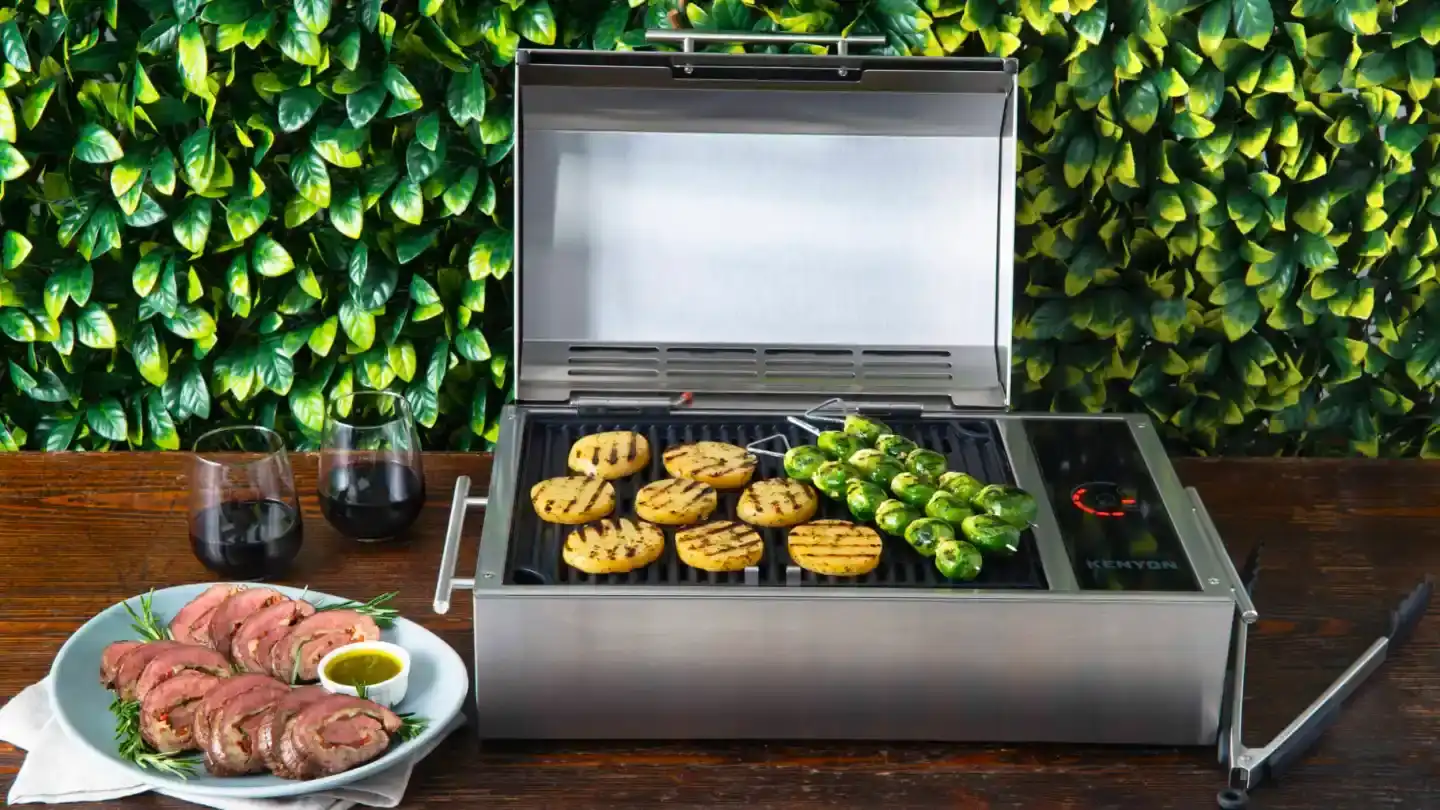
The Frontier Portable (model B70090, or B70590 with IntelliKEN touch controls) is Kenyon's longest-running portable. At 1,300 watts, it draws about 11 amps on a 120V circuit, reaches 550°F in roughly seven minutes, and offers 155 square inches of cooking surface, enough for six burgers, four medium steaks, or a protein-and-vegetable mix for two to four people.
Dimensions are 21 × 12 × 8.75 inches; weight runs 24–28 pounds depending on the configuration.
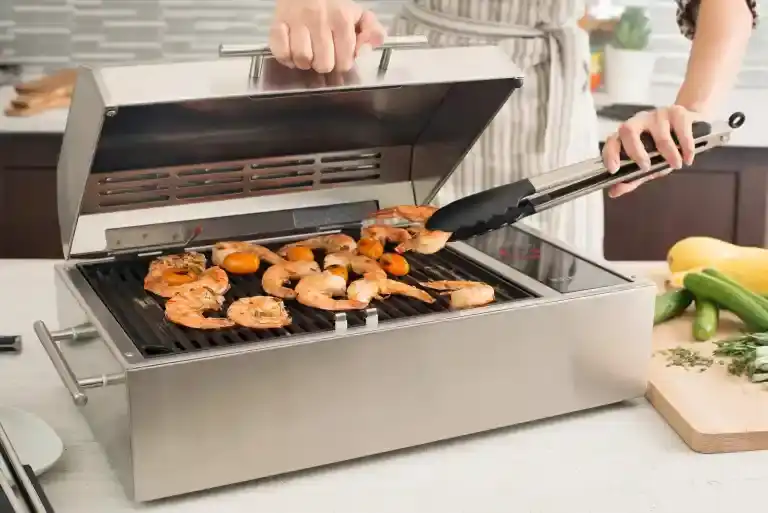
The cast-aluminum grate and drip tray are dishwasher-safe. Pricing at BBQGuys and similar retailers runs $1,200–$1,500 depending on control type and availability. If you don't need the SilKEN's collapsible lid or the G2's extra cooking area, the Frontier is the uncomplicated choice.
SilKEN Portable: for tight bay storage
The SilKEN Portable (model B70072) addresses the most common complaint about grills in a coach: where do you actually put it? Kenyon's answer is a high-temperature silicone lid that collapses to roughly two inches. With the lid folded, the SilKEN slides into shallow drawers and compartments that a standard Frontier won't fit. The silicone stays cool to the touch during cooking, which is genuinely useful when you need to check food mid-session.

Performance specs match the Frontier almost exactly: 1,300 watts, 550°F, 155 square inches, 24 pounds, marine-grade 304 stainless. The premium is real. The SilKEN typically lists above $1,500, and whether that's justified depends entirely on whether bay storage is your binding constraint. For 45-foot conversions where every inch counts, it usually is.
G2: the entertaining option
The G2 Grill is Kenyon's largest portable and the model for owners who host regularly. Cooking surface jumps to 213 square inches, enough for a full rack of burgers, several steaks simultaneously, or a mixed grill for six to eight people. The heating element is rated at 1,440 watts (approximately 12 amps), so keep an eye on your coach's electrical load if you're drawing from an inverter rather than shore power.
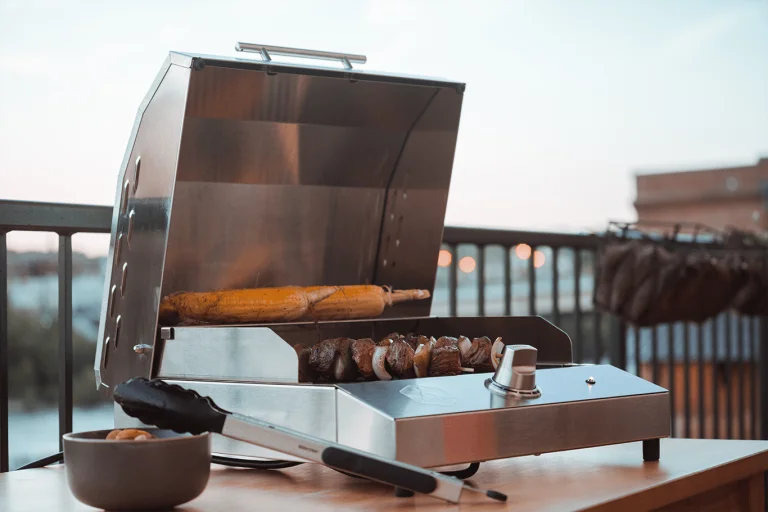
Controls are a single rotary dial with suggested temperature settings for common foods printed on the face, simpler than the touch panels on the Frontier and SilKEN variants.
The G2's MSRP is $949; Kenyon's own site has run it around $807. At that price, it's both Kenyon's biggest grill and the most affordable per square inch of any model in the lineup. The trade-offs are weight (37 pounds) and a larger footprint, so storage planning is required. If you entertain often or just want to cook everything in one pass, this is the model.
Two-to-four people, compact footprint
155 sq in, 1,300W, 11A draw. Frontier fits most bay drawers as-is. SilKEN's collapsible silicone lid unlocks the tightest compartments. Priced $1,200–$1,500+ depending on model. Right for owners who cook daily for a couple and want simplicity.
Six-to-eight people, lowest cost per sq in
213 sq in, 1,440W, 12A draw, 37 lbs. Single dial controls, suggested temps printed on face. MSRP $949, often ~$807 direct. Kenyon's best value if you have the storage space and host regularly.
Power and off-grid use
All three grills are current-hungry by motorcoach standards. On a 50-amp shore power pedestal that's a non-issue, but boondocking changes the math. Running the Frontier or SilKEN on an inverter requires at minimum a 2,000-watt pure sine wave unit and a capable lithium bank; the G2's draw is similar. Thirty minutes of cooking on the Frontier consumes roughly 650 watt-hours. That's manageable on a newer coach with a full lithium upgrade. On an older build that hasn't had its electrical systems refreshed, it can be a stretch.
How the Kenyon lineup fits the broader market
The main propane-based competitor from the yachting world is the Magma Marine Kettle, a proven grill that uses propane and won't run afoul of resort bans on open flame. The Ninja Woodfire Outdoor Grill (~$370) adds electric ignition and wood-pellet flavoring that Kenyon lacks; it's a legitimate option if smoke flavor is a priority and you don't need the marine-grade build. Weber's Q1200 remains the benchmark for portable gas grills. Cuisinart's FlavorBoost CEG-1302, released in April 2026 at $379.99, is the most affordable electric entry, though it doesn't carry Kenyon's American manufacturing or stainless spec.
Kenyon's edge is the combination: marine-grade construction, smokeless operation, UL approval for indoor/outdoor use, and aesthetics that hold up next to a coach worth seven figures. If the grill lives in the bay year-round, those things matter more than they do for occasional weekend use.
If your coach setup includes a Starlink installation or other shore-power-dependent gear, it's worth mapping total amperage before adding a Kenyon to the mix, especially the G2's 12-amp draw.
The right Kenyon isn't whichever model reviews best. It's whichever one matches how you actually cook and where your coach actually stores things.
Quick comparison: all three models at a glance
- Frontier Portable (B70090 / B70590) — $1,200–$1,500
155 sq in · 1,300W · 11A · 550°F · 24–28 lbs · 21 × 12 × 8.75 in · dishwasher-safe grate and tray · dial or IntelliKEN touch controls
- SilKEN Portable (B70072) — $1,500+
155 sq in · 1,300W · 11A · 550°F · 24 lbs · collapsible silicone lid (~2 in folded) · cool-touch lid surface · same stainless build as Frontier
- G2 — ~$807–$949
213 sq in · 1,440W · 12A · 37 lbs · single rotary dial · suggested temps printed on face · best per-square-inch value in the lineup
Frequently Asked Questions
Can I use a Kenyon grill where propane grills aren't allowed?
Yes. All three Kenyon portables are UL-approved for indoor and outdoor use and produce no open flame. Most luxury RV resorts that ban propane and charcoal will permit them, as will hotel balconies and federal campgrounds under fire restrictions. It's always worth confirming specific site rules before you set up, though.
How much power does a Kenyon grill use on an inverter?
The Frontier and SilKEN draw 1,300 watts (roughly 11 amps at 120V); the G2 draws 1,440 watts (roughly 12 amps). A 30-minute cooking session on the Frontier consumes approximately 650 watt-hours. You'll want at minimum a 2,000-watt pure sine wave inverter and a healthy lithium bank. Coaches with older or smaller battery systems may find it difficult without a shore power connection.
What's the real difference between the Frontier and the SilKEN?
Performance is nearly identical: same wattage, same cooking surface, same temperature ceiling, same weight. The SilKEN's collapsible silicone lid folds down to about two inches, letting it fit into shallower compartments that the Frontier's fixed profile won't clear. You're paying $300–$400 more for that storage flexibility. If your bay has the room, the Frontier is the better value.
Is the G2 actually the most affordable Kenyon portable?
On a per-square-inch basis, yes. The G2 offers 213 sq in at an MSRP of $949 (often ~$807 direct from Kenyon), while the Frontier's 155 sq in lists at $1,200–$1,500 and the SilKEN's 155 sq in lists above $1,500. The trade-off is weight (37 lbs) and a larger footprint. If storage space isn't the constraint, the G2 is the straightforward value pick.
How does Kenyon compare to the Magma Marine Kettle or Ninja Woodfire?
The Magma Marine Kettle uses propane and comes from the same yachting world as Kenyon. It's proven hardware, but it won't help you at a resort with a flame ban. The Ninja Woodfire (~$370) offers electric ignition and wood-pellet smoke flavor, which Kenyon doesn't replicate; it's a reasonable option if smoke taste is a priority and you don't need marine-grade stainless. Kenyon's edge is the combination of build quality, American manufacturing, UL dual-use certification, and aesthetics that hold up alongside a high-end conversion.
Do Kenyon grills rust if stored in a coach bay?
Kenyon builds all three models from marine-grade 304 stainless steel and backs them with a lifetime guarantee against rust. Storing the grill slightly damp after use in rain shouldn't be a problem over time, which is the same standard Kenyon holds its yacht-grade products to.