In this article
- 01How the Garmin RV lineup is structured in 2026
- 02What's in the box and what to know before you mount it
- 03What makes the routing actually useful for large coaches
- 04The connected features: what works with the Garmin Drive app
- 05Notable extras that don't make the headline but matter in practice
- 06How the RV 895 compares to the competition in 2026
- 07RV 895 vs. RV 1095: which one for a Prevost?
- 08Frequently Asked Questions
If you're piloting a 45-foot Prevost, the gap between "good enough" navigation and navigation that actually fits your rig is larger than most people expect. A standard phone app doesn't know your coach is 13 feet tall, 8 feet wide, and 56,000 lbs GVWR. It will happily route you under a 12-foot bridge or across a weight-restricted back road and let you figure out the rest.
The Garmin RV 895 launched in 2023 with a direct answer to that problem. Three years on, the competition has sharpened: the RV 1095 is pulling fans away from the 895, and RV LIFE Pro has become a serious phone-based alternative. Here's an honest look at where the 895 still earns its place on the dash and where it doesn't.
How the Garmin RV lineup is structured in 2026
Garmin makes three RV-specific GPS units. They run identical software; the only real differences are screen size and price:
- RV 795 — 7-inch, $449.99
Best for smaller coaches, tow vehicles, and Class B/C rigs. Undersized for a Prevost dash.
- RV 895 — 8-inch, $699.99
The middle option. Readable without dominating the dash. Most Class A owners land here.
- RV 1095 — 10-inch, $899.99
The big-screen option. Same maps and routing as the 895, but speed limits and exit services are readable at a glance from the captain's chair. Getting popular among H3-45 and X3-45 owners with wide, flat dashes.
There's also the RVcam 795 ($599.99), which is the 795 with a built-in dash cam, if you want to consolidate hardware. For Prevost owners, it comes down to the 895 vs. the 1095, and we'll get to that directly.
What's in the box and what to know before you mount it
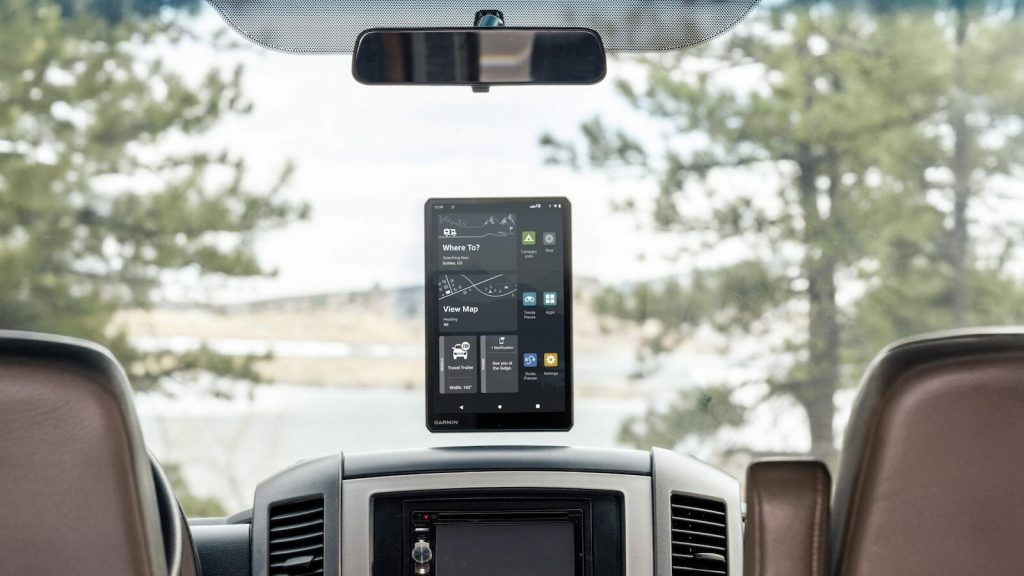
The 895 ships with a powered magnetic mount, a screw-down mount, a 1-inch ball adapter compatible with RAM and Bulletpoint systems, a vehicle power cable, and a USB cable. Physical dimensions: 7.9 × 4.9 × 0.8 inches, about 14 oz, 32 GB internal storage with a microSD slot for expansion. The 1280 × 800 IPS display works in landscape or portrait, which matters if your dash layout is non-standard. Battery life is rated for roughly two hours, enough for pre-trip planning at home but not enough to go unplugged while driving.
What makes the routing actually useful for large coaches
You enter your coach's height, length, width, weight, and propane status when you first set up the device. You can save multiple vehicle profiles, which is useful if you also have a toad or a tow vehicle with different specs. Once configured, the 895 avoids tight clearances, weight-restricted bridges, and roads that aren't rated for your rig's size. That's the foundational value, and it still holds up.
The proactive road warnings go further: steep grades, sharp curves, weight limits, narrow lanes, and animal crossings are often flagged before you reach the decision point, not after. Elevation profiles let you preview a mountain pass before you commit to it. On a cross-country run from Texas to Montana, those alerts mean the difference between a smooth day and a situation.
Garmin Voice Assist handles address entry and basic commands reasonably well, though it gets less reliable with complex requests. Built-in Bluetooth handles hands-free calls.
The connected features: what works with the Garmin Drive app
Pair the 895 with the Garmin Drive app, either through your phone or via your coach's Starlink connection, and the device adds:
Live traffic and incident rerouting
Animated weather radar with severe-weather alerts along your route
Live fuel prices with diesel broken out, genuinely useful for budgeting a 2,000-mile run
Pilot and Love's integration with real-time shower availability, parking status, and loyalty points
Smart notifications mirroring texts and alerts from your phone
The Drive app also lets you plan the full trip on a laptop or tablet, then push the route to the 895 before you leave. BirdsEye Satellite Imagery rounds this out with high-resolution aerial views of campgrounds and RV parks, so you can check whether that entrance is actually 14 feet wide before you pull up.
Notable extras that don't make the headline but matter in practice
Wireless map updates. The 895 updates maps and software over Wi-Fi without a computer. Worth mentioning because the older Garmin workflow required a laptop and Garmin Express, so this is simpler.
Backup camera support. The device pairs with Garmin's BC 50 wireless backup camera. Reviews on the BC 50 are mixed; most Prevost owners with factory-installed camera systems skip it entirely and use what they already have.
PowerSwitch compatibility. If you've installed Garmin's PowerSwitch module, you can control 12-volt accessories (lights, fans, awnings) directly from the navigator screen. Niche, but a clean integration if you're already in the Garmin ecosystem.
Campground directory. Preloaded with KOA, Ultimate Public Campgrounds, iOverlander, and U.S. National Parks, plus Tripadvisor and Foursquare POIs. If you're running a Prevost into higher-end motorcoach resorts, verify the resort is in the database before you depend on it. Coverage for premium resort properties is uneven.
How the RV 895 compares to the competition in 2026
The dedicated-hardware case
Works offline, always. RV-custom routing with height/weight/width profiles. Grade and clearance alerts before you need them. No cell service required for core function. The 895 is $699.99; the 1095 is $899.99 for a bigger screen and the same software.
The app-based case
RV LIFE Pro ($65–$99/yr) combines RV-safe routing, a large campground database, and Trip Wizard for pre-planning. Excellent when you have signal. Unreliable in canyons, high elevations, and rural stretches where full-timers lose service most often. CoPilot RV (one-time purchase) is a solid phone-based backup.
The Garmin dēzl OTR1000 ($799.99) is worth a mention. It's a 10-inch trucker-focused unit with stronger fuel-stop and weigh-station data. Some Prevost owners who run interstates heavily prefer it because trucker routing often matches how a 45-foot coach actually drives. The Rand McNally TND 1050 (~$499.99) has solid hardware but has lost ground since Rand McNally discontinued their TripMaker planning tool. The TomTom GO Camper Max (~$399.99) is common in Europe and fine for smaller RVs; the 7-inch screen is too small for a Prevost dash.
The honest case for the dedicated 895 is the same as it was at launch: it works when your phone doesn't. Canyons, national park interiors, high-elevation passes, remote stretches — the Garmin keeps routing while apps that depend on a data signal stall out. That reliability gap is real, and it's why the dedicated unit still belongs on the dash of a coach doing serious mileage.
RV 895 vs. RV 1095: which one for a Prevost?
If you already own the 895 and it's working for you, skip this section. The 1095 runs the same software and there's no functional upgrade to chase. If you're buying new:
- Pick the 895 if dash footprint matters
The 8-inch screen is readable without encroaching on your sightline. Better for coaches with a tighter dash layout or where you want the device to stay unobtrusive.
- Pick the 1095 if your dash is wide and flat
The extra two inches make speed limits, exit services, and turn notifications readable at a quick glance from the captain's chair, which sits farther from the dash in a 45-foot coach than in most smaller RVs. Forum consensus leans toward the 1095 for H3-45 and X3-45 owners, but a meaningful number prefer the smaller footprint of the 895. Try both in person if you can.
The 895 doesn't need to be the biggest screen on the market. It needs to keep a 45-foot coach off a 12-foot bridge, and it does that every time.
Frequently Asked Questions
Is the Garmin RV 895 worth it for a Prevost specifically?
Yes, with one caveat. The RV-custom routing (height, weight, and width profiles plus grade and clearance alerts) is genuinely valuable for a 45-foot coach that can't take "just recalculating" for a low bridge. The caveat: if your Prevost has a wide, flat dash, you might prefer the RV 1095's 10-inch screen at $899.99. Both run identical software.
What's the difference between the Garmin RV 895 and RV 1095?
Screen size and price only. The RV 895 has an 8-inch display and retails for $699.99; the RV 1095 has a 10-inch display at $899.99. Maps, routing logic, alert system, connected features, and campground database are identical across both units. If you already own an 895, there's no functional reason to upgrade.
Can the Garmin RV 895 work without a phone or cell signal?
Yes, and that's its core advantage over app-based alternatives. The 895 stores full maps onboard (32 GB internal, expandable via microSD) and routes locally. Live features like real-time traffic, fuel prices, and weather radar require a connection via the Garmin Drive app, but the navigation itself doesn't. In canyons, national park interiors, and remote stretches, it keeps routing when RV LIFE Pro and Google Maps stall.
How do I mount a Garmin RV 895 on a Prevost dash?
The included suction-cup mount doesn't adhere reliably to the textured surfaces common on Prevost dash panels. Most owners replace it with a RAM adhesive base (model RAM-B-121) or a Bulletpoint mount, both of which accept the 895's included 1-inch ball adapter. Budget an extra $30–$50 for the mount and skip the suction-cup frustration.
Is RV LIFE Pro better than the Garmin RV 895?
For pre-trip planning and campground research, RV LIFE Pro ($65–$99/yr) is genuinely excellent. Trip Wizard in particular is the best route-planning UI in the category. But it depends on cell service for live routing data, which is precisely when full-timers lose signal most. The Garmin works offline. Most coaches that travel rural routes run both: Garmin on the dash, RV LIFE Pro on a tablet for planning.
Does the Garmin RV 895 support a backup camera?
Yes. It pairs wirelessly with Garmin's BC 50 backup camera. Reviews on the BC 50 are mixed; image quality in low light is a common complaint. Most Prevost owners with a factory-installed camera system skip the BC 50 entirely and use their existing setup, which is almost always higher quality.