In this article
My first year with a coach, I did something I'd recommend to exactly nobody: I threw every receipt into a file folder in the bay and refused to look at the pile until January. Fuel, a tire invoice, the shop ticket from the week I chased an air leak across two states, storage, the insurance renewal. Then one cold morning I sat down with a calculator and added it all up.
The total wasn't what got me. I'd braced for the total. What surprised me was the shape of it. How little was the stuff I'd worried about when I bought the thing, and how much was the stuff nobody at the dealership brings up.
So let's talk about that honestly. Not the brochure version. The file folder version.
The purchase price is the easy part
Here's the thing about a Prevost: the number on the listing is the only number in this whole conversation that anyone will tell you straight.
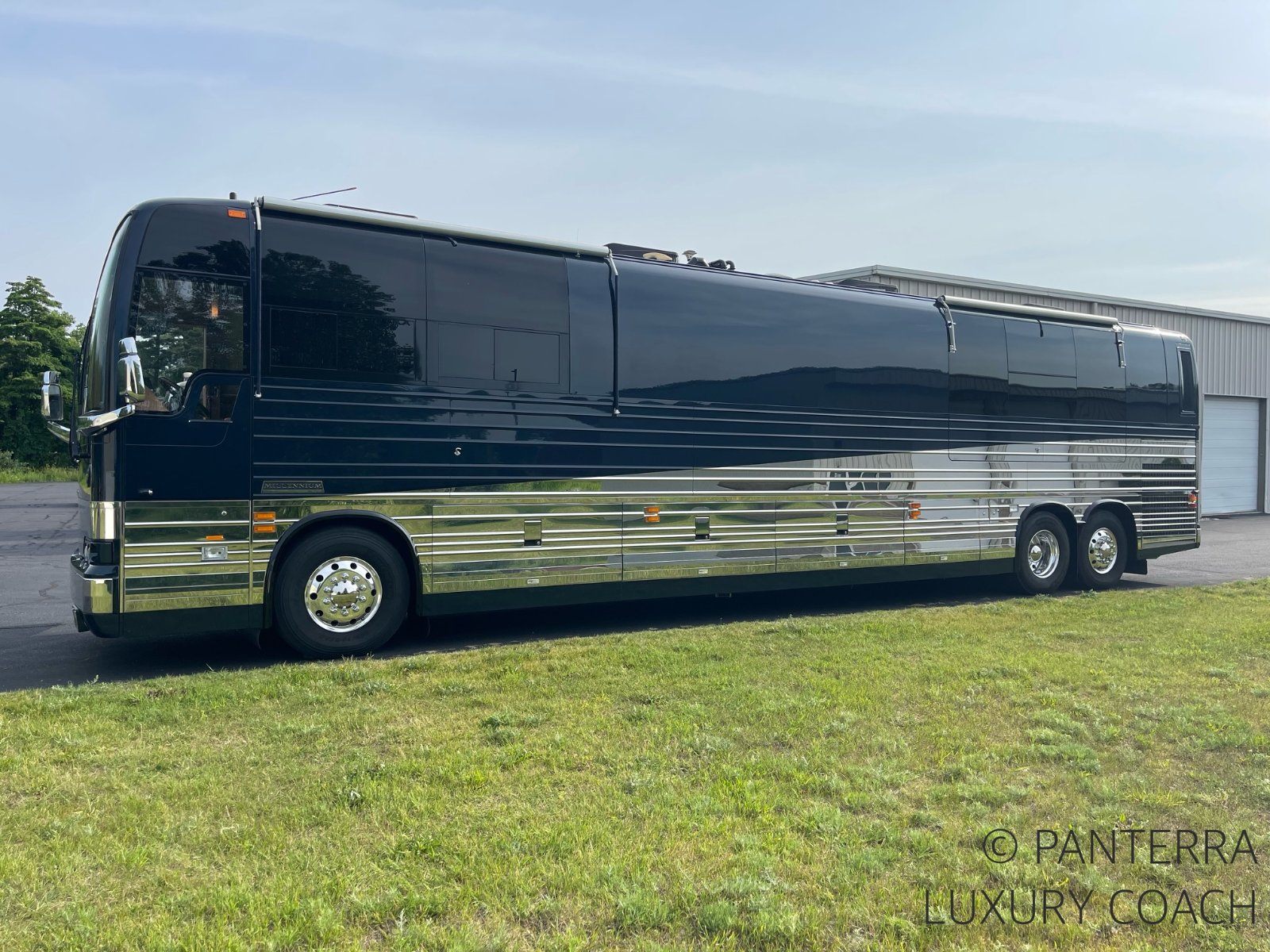
New, a fully converted Prevost luxury coach runs somewhere between $1.8 million and $3.2 million and up, depending on which converter built it and how much you asked them to do. Used is where most of us actually live, and the spread is enormous. Recent asking prices on H3-45 conversions have run from around $220,000 for an early-2000s coach up to roughly $846,000 for a 2016, with the middle of the market hovering near $389,000. X3-45 conversions have been asking anywhere from $429,000 to $949,000.
Take those figures as directional rather than gospel. At any given moment only a handful are listed nationwide, and average time on market runs about 120 days. These don't move like pickup trucks.
Which brings up what makes Prevost ownership genuinely different: a well-kept coach with a good converter's badge holds value in a way a production Class A simply does not. Converter brand is the single biggest driver of resale. Liberty and Marathon command real premiums, and documented service history matters more than odometer reading at this tier. I've watched coaches with 400,000 miles and a thick maintenance binder sell for more than lower-mileage coaches with a shrug for paperwork.
Insurance: cheaper than you'd think, with one catch
You're driving a $500,000 vehicle. You'd expect the insurance to be terrifying. It mostly isn't. Luxury coach policies typically run $3,000 to $8,000 a year, with coaches north of a million sometimes needing specialized programs above that. For equipment worth as much as a house, that's not unreasonable.
Storage: the bill that shows up whether you travel or not
This is the line item people forget entirely, and for a 45-foot coach it isn't small.
- Outdoor — $1,600–$3,240/yr
$3–$6 per linear foot per month. Lowest cost, highest paint exposure. Fine for dry climates with a quality cover.
- Indoor — $3,240–$6,480/yr
$6–$12 per foot per month. The middle ground most full-timers land on when they're not at a resort.
- Climate-controlled — $8,100–$13,500/yr
$15–$25 per foot per month. A quality respray runs $20,000–$30,000. Three years of climate-controlled storage costs less than one paint job.
Fuel and campgrounds: the honest math
Fuel is the straightforward one. Diesel hit a record August high of about $5.40 a gallon nationally. A coach returns six to eight miles per gallon depending on terrain, weather, towing, and how heavy your right foot is. Call it seven. At $5.40, that's roughly 77 cents a mile: 5,000 miles a year is about $3,900 in diesel, 10,000 miles about $7,700. Add DEF, tolls, and the occasional eye-watering fill-up in California.
Then there's where you park. Public and state parks run $20–$45 a night, though plenty won't take a 45-footer. Private campgrounds go $55–$95. Luxury RV resorts (the kind with sites actually built for big rigs, like Hearthside Grove) run $110–$250 and up, clearing $200 in Sunbelt high season. Monthly at a resort is $2,200–$4,500 plus metered electric. Six months in Arizona at resort rates is a genuine second mortgage, and that's the number that separates the weekend owner from the snowbird.
Prevost maintenance: where the real money lives
Start with the good news, because it's genuinely good. The chassis is bus-grade equipment engineered to run a million miles in commercial service, and Prevost will sell you a preventive maintenance agreement covering it for, in their words, as low as $15 a day, about $5,475 a year for oil and filters, gearbox and axle fluids, cooling system pressure tests, belts, valve clearance, brakes, suspension, steering, three-axle alignment, and inspection. For a 45-foot diesel coach, that's a bargain, and it's the most predictable money you'll spend.
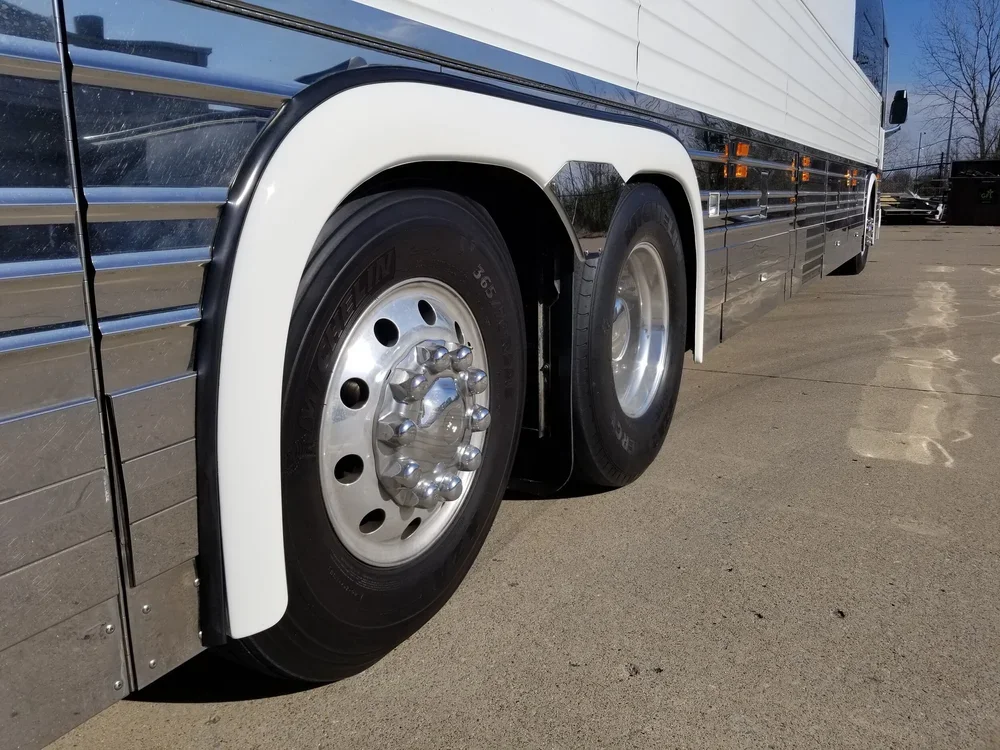
Tires are equally predictable if less pleasant. Coach tires run about $1,268 each plus federal excise tax, so a full set of six to eight is north of $8,000 installed. Here's what catches people: coach tires age out on date codes, not tread depth. Most owners replace at six to seven years regardless of wear. Put 4,000 miles a year on the coach and you're still buying tires with plenty of tread left. Budget $1,200–$1,800 a year and stop treating it as a surprise.
Where Prevost maintenance actually gets expensive
The chassis is knowable. Tires are knowable. The conversion is neither.
Prevost builds a shell and a drivetrain. Then a converter installs entirely custom plumbing, 12- and 24-volt electrical, inverters, house batteries, a generator, HVAC, and cabinetry. Each one differently, in a different year, with parts chosen from whatever was good at the time. That's why the recurring headaches in owner communities cluster in the conversion rather than the engine bay.
- Air system leaks and suspension
There are separate long-running forum threads titled "Chasing Air Leaks," "Coach leaks down after 10-12 days," and "leaning coach syndrome." These aren't edge cases. They're the most common conversion-side complaint for owners of coaches more than a decade old.
- HVAC
Older Cruise Air systems are described plainly in owner forums as very expensive to repair when they go. Parts availability varies by converter generation.
- Inverters, chargers, batteries, and generator
Something as mundane as a corroded 24-volt terminal quietly starves everything downstream and gets misdiagnosed three times before anyone finds it. The power stack is the most failure-prone, most time-consuming, and most specialized category on the conversion side.
None of that is catastrophic. All of it is tedious, hourly, and specialized. Budget $5,000–$15,000 a year for conversion-side work on an older coach and count a light year as luck. That's an estimate from my own shoebox, not a published figure. Nobody publishes this one, which is exactly why everybody underestimates it.
The annual picture
Category | Typical annual range | Notes |
|---|---|---|
Insurance | $3,000–$8,000+ | Agreed value, not actual cash value |
Storage | $1,600–$13,500 | Outdoor to climate-controlled, 45 ft |
Fuel | $3,900–$7,700 | 5,000–10,000 mi at ~7 mpg, $5.40/gal |
Campgrounds | $2,000–$27,000+ | Weekender to six months at a resort |
Chassis PM | ~$5,475 | Prevost agreement at $15/day |
Tires (amortized) | $1,200–$1,800 | Replaced on age, not tread |
Conversion repairs | $5,000–$15,000+ | Owner estimate; the wildcard |
Depreciation deliberately isn't in that table. On a good coach with a strong converter badge and a complete service binder, it can be remarkably small. On a neglected coach with deferred maintenance, it's the largest number on the page by a wide margin. Same asset, opposite outcomes, and the difference is the binder.
The expensive coach isn't the one with the high purchase price. It's the one with the thin maintenance file.
Every dollar of deferred Prevost maintenance shows up twice: once when you finally pay to fix it, and again when you sell and a knowledgeable buyer walks the bays with a flashlight and prices your neglect for you. The owners I know who spend the least over a decade are the ones who spent the most in year one, sorting out air leaks and electrical gremlins properly instead of chasing them every season.
Budget the boring stuff generously. Buy the binder, not the paint.
Frequently Asked Questions
How much does it cost to own a Prevost coach per year?
Total annual operating costs typically range from $18,000 to $73,000 depending on how far you travel and where you stay. The widest variable is campground spending. A weekender putting 5,000 miles on the coach and staying in state parks might land at $18,000–$25,000. A snowbird logging 10,000 miles and spending six months at a Sunbelt luxury resort can clear $60,000–$73,000 before unexpected repairs. Conversion-side maintenance is the category most owners underestimate.
What does a Prevost preventive maintenance agreement cost?
Prevost's Uptime Service Agreement covers chassis PM (oil and filters, gearbox and axle fluids, cooling system pressure tests, belts, valve clearance, brakes, suspension, steering, and three-axle alignment) starting at $15 a day, or roughly $5,475 a year. That's a strong value for bus-grade equipment. It covers the chassis only; converter-side systems (HVAC, electrical, plumbing) aren't included.
How often do Prevost coach tires need to be replaced?
Coach tires age out on date codes, not tread depth. Most owners replace at six to seven years regardless of remaining tread. A full set of six to eight Michelin X Line Energy Z tires runs about $1,268 each plus federal excise tax, so budget $8,000–$10,000 per replacement cycle, or roughly $1,200–$1,800 a year amortized. Low annual mileage doesn't reset that clock.
Is agreed value or actual cash value better for luxury coach insurance?
Agreed value, without question. An actual-cash-value policy lets an adjuster apply depreciation to a custom conversion interior that has no published book value, and the payout can be a fraction of what replacing the coach would actually cost. Agreed value locks in the insured amount when you write the policy. Expect to pay $3,000–$8,000 a year for a quality luxury coach policy; coaches over $1 million often need specialized programs above that range.
What are the most common maintenance problems with older Prevost coaches?
Chassis problems are rare. The drivetrain is engineered for a million miles of commercial service. The recurring issues are on the conversion side: air system leaks and suspension (a perennial topic in the Prevost Owners Group forum), HVAC failures in older Cruise Air systems, and electrical gremlins in the 12- and 24-volt stack, particularly corroded terminals that starve inverters and chargers. Budget $5,000–$15,000 a year for conversion-side work on a coach older than ten years.
Does converter brand affect Prevost resale value?
Yes, it's the single biggest driver after overall condition. Liberty and Marathon command real premiums in the used market. A coach with a strong converter badge, documented service history from authorized shops, and a complete maintenance binder will sell for more than a lower-mileage coach with thin paperwork. At this tier, the binder is worth real money. In some cases $25,000–$75,000 in documented maintenance adds more value than it cost.
How does Prevost coach storage cost compare to repainting?
A quality full respray runs $20,000–$30,000. Three years of climate-controlled indoor storage at $8,100–$13,500 a year costs roughly the same, and prevents the condition that makes a respray necessary. Outdoor storage at $1,600–$3,240 a year is tempting, but UV exposure and weather cycles accelerate paint and seal degradation on a 45-foot coach significantly faster than on a passenger vehicle.